NSW Records 1,180 Emergency Visits Mentioning Unapproved Peptides
NSW Health issued a public warning on October 19 about unapproved peptide products. Its report counted 1,180 emergency presentations mentioning use from July 2025 through September 2026. These are visits, not unique patients or confirmed drug-caused injuries.[1][2]
What was counted
Researchers searched triage text for people aged 16 and over at 88 reporting hospitals. Historical use, missed records and changing documentation limit interpretation. No user-population denominator is available to estimate individual risk.[1]
Mention does not establish causation. This is descriptive surveillance, not a controlled safety study.
Visual breakdown
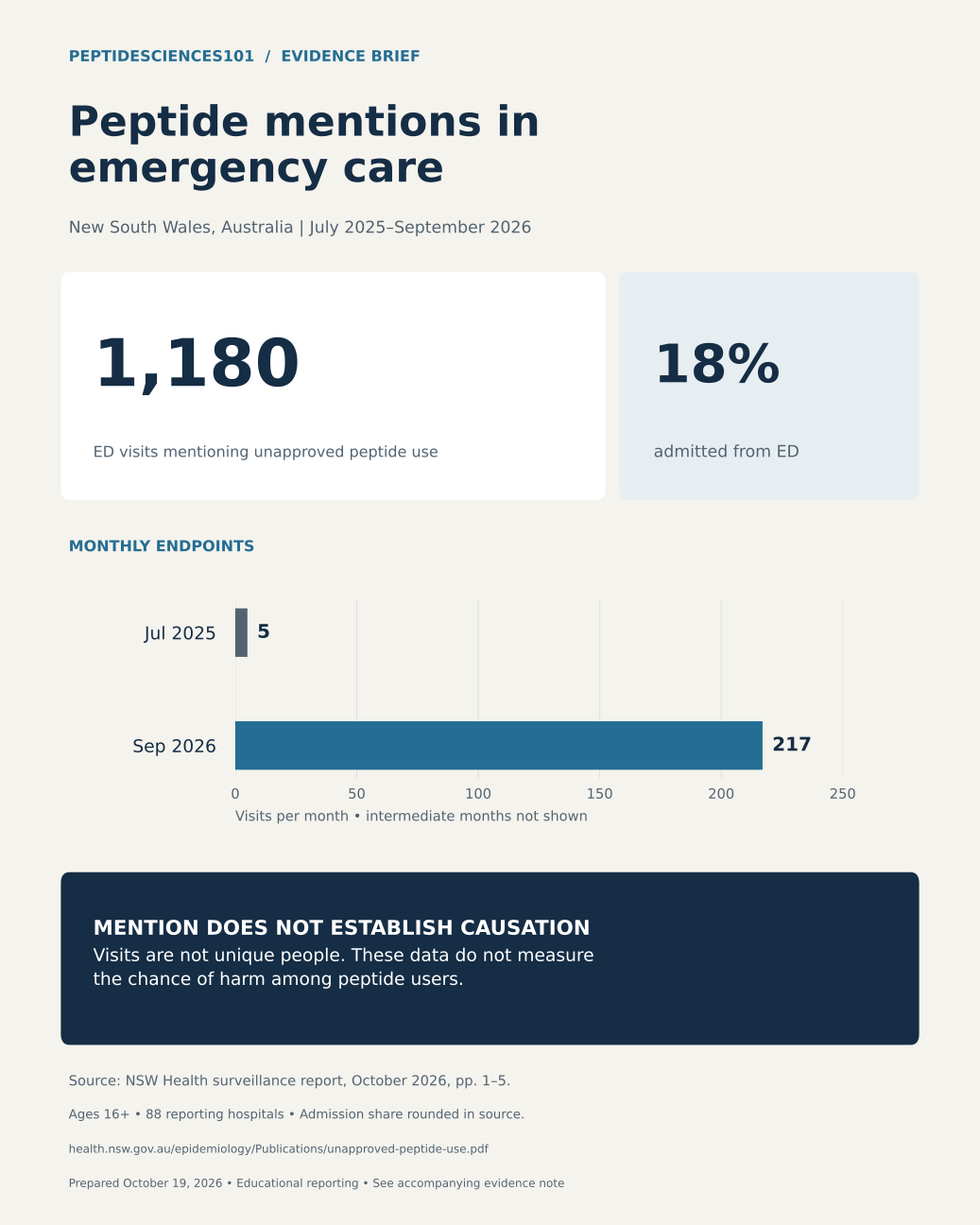
| Measure | Reported value |
|---|---|
| Visits in the surveillance period | 1,180 |
| Admitted from ED | 18% |
| July 2025 visits | 5 |
| September 2026 visits | 217 |
A category that needs clarification
The summary labels 833 visits “retatrutide only,” alongside 445 other/generic mentions and 98 mentioning both. The arithmetic fits overlapping totals: 833 + 445 − 98 = 1,180. This does not resolve what “only” means. We therefore withhold a retatrutide-share chart pending clarification.[1]
A product name is not chemical confirmation
Separately, TGA reported on September 14 that a tested product sold as retatrutide contained semaglutide and no retatrutide. That finding concerns one investigated product; it does not identify the contents of products involved in the NSW dataset.[3]
What readers should take away
NSW Health warns that packaging and purity claims do not establish safety. It advises discussing these products with a qualified health professional and checking medicine registration.[2]
Our interpretation: this warrants attention as a government surveillance signal. It cannot rank compounds by safety or establish that retatrutide caused a specified number of emergencies. The October 19 document is an Australian safety warning and should not be presented as a new U.S. compounding decision.
Evidence type: official descriptive surveillance. No compound evidence grade is assigned. The report is dated October 2026; an exact October 17 publication date has not been independently established.